
 |
 |
 |
 |
Czech Puppet Maestro shattered records with the world's largest pomlázka: a ceremonial whip made from willow branches for Czech fertility rituals.
Is your pomlázka too small? Leave it to this puppet theater maestro.
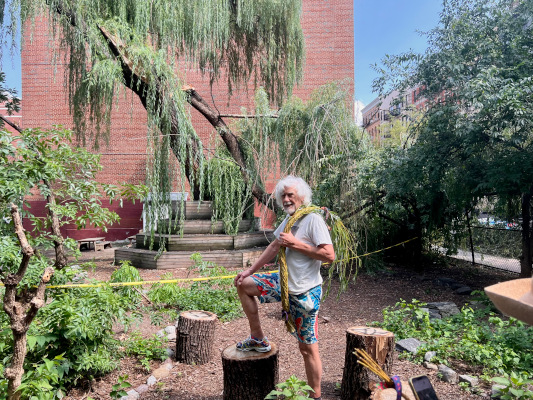 |
| Vít Horejš in Paradise
Garden among willows. |
On August 9, 2026 (between 11:28 AM and 2:26 PM), in El Jardín Del Paraisom 309-311 East Fourth Street, Manhattan, Master Folk Tradition Bearer and Itinerant Marionetteer Vít Horejš broke his own world record in braiding a pomlázka -- a willow whip used in Czech Springtime fertility ceremonies. In under three hours, Horejš braided a record 82 willow twigs into a monstrous braid festooned with traditional colorful ribons, far surpassing his own record of 28 twigs which was set in 1963, coinciding with the first steps of what was to become known as "Prague Spring."
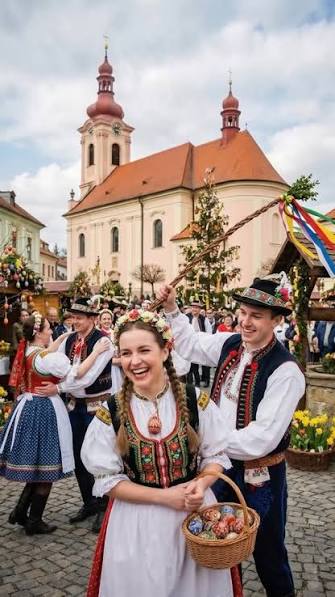 |
| Woman with basket of
eggs, man with pomlázka, in Czech ceremony. |
The whips are used in a traditional Czech pre-Christian fertility ceremony that is harmless, except for your dignity. A whip, braided from 4 to 12 freshly sprouted willow twigs, is used for ceremonially whipping women and girls to rejuvenate them. The women pay for the privilege with elaborately painted eggs, another fertility symbol. This Old-World tradition is now celebrated on Easter Monday but probably predates the arrival of Christianity in Czech lands. Young men of a village walk house-to-house with long, flexible whips made out of woven willow twigs, often decorated with colorful ribbons, and spank the girls with them on their behinds. The ritual prevents the women from “drying up” during the rest of the year. The women feign running and hiding, then allow themselves to be caught, and upon receiving the spanking, they say “thank you” and return the favor by giving the boys elaborately decorated eggs and a belt of Slivovitz. It all takes about 20 seconds. Vit Horejš says when he was a boy, it was an obligation for him to spank his grandmother and his aunts.
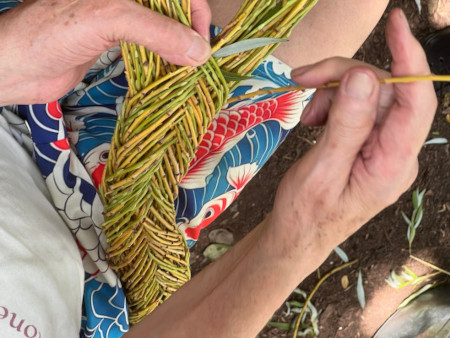 |
| Hands of Vít Horejš
weaving 82 willow twigs. |
Today, there are competitions for braiding pomlázka in the Czech Republic, particularly during the Easter season, celebrating the skill involved in creating these traditional Easter whips. Pomlázka braiding competitions in Prague are often commercial and tourist-oriented, showcasing intricate designs and attracting visitors. Competitions in rural areas typically emphasize local customs and craftsmanship, reflecting a deeper connection to the cultural heritage of the tradition. The benchmarks of competition in Czech lands are unmistakably high and a whip of eight strands is considered standard. The complexity of braiding increases with the number of twigs used, making these competitions a showcase of craftsmanship.
 |
| Postcard celebrating the tradition
in Czech Republic |
While pomlázka is an Easter tradition, it requires an abundance of long willow twigs, which must be stripped of leaves to be woven. That's why Horejš made his whip in the summer. The calendar doesn't dictate when a suitable willow limb is going to drop into your back yard.
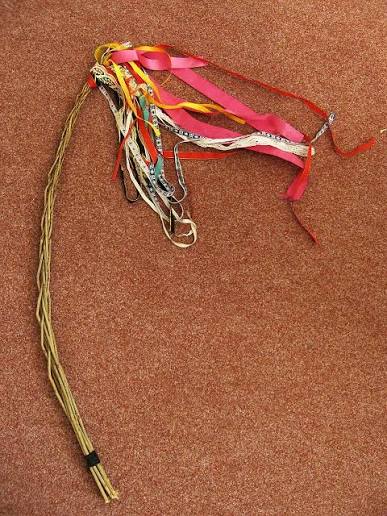 |
| Standard-sized pomlázka
with ribbons. |
Horejš, born and raised in Prague in 1950s, is a self-taught pomlázka maker who often broke the limits of the craft, braiding way over the standard maximum of twelve willow twigs, eventually reaching as many as 28 in a lethal-looking giant pomlázka, braided in 1963. This past Easter, he had set out to more than double his record and establish a Guinness Book Record for the art. But despite his 192 cm (6’4”) height, he couldn’t reach enough long twigs on two upstate willow trees he was sourcing from. The project stalled until August 5, a day of intense rain, when a major branch broke from a willow tree in El Jardín Del Paraiso, next to his residence. (He lives in a 100-year old tenement on East 4th Street, in what was a Czech and Slovak neighborhood until the second half of the 19th Century when its members moved uptown, leaving the Alphabet Avenues to their Ukrainian, Polish and Jewish neighbors.) The tree had been designated a "great tree of New York" by the Parks Department. Representing over a third of this mighty willow, this branch provided enough extremely long twigs for what promised to become "The mother of all Easter Whips."
 |
| Elaborately painted eggs. |
Since the Guinness Book of Records so far ignored the application for inclusion of this milestone achievement, the record may become a crowning jewel in "The Hitchiker's Guide to the Southern Cross Constellation Record Book" instead.
About Vít Horejš
Mr. Horejš, an émigré from Prague, founded Czechoslovak-American
Marionette Theatre (CAMT) in 1990, utilizing century- old Czech puppets discovered
at Jan Hus Church on East 74th Street. His trademark is using puppets of many
sizes, from six-inch toy marionettes to twelve-foot rod puppets. He has translated,
written, adapted, and directed over two dozen marionette plays for CAMT, is
a resident artist at La MaMa Theater and honored to also be a frequent artist
at Theater for the New City. He has performed on stage, film, and TV. Published
works: Twelve Iron Sandals (1985); Pig and Bear (1989); and Faust (1993).
He starred in an Onur Tukel feature film, "Scenes From an Empty Church"
(2021) and "Wooden Hearts" (2026), and Carnegie Hall/Centro Primo
Levi film "The Scandal of the Imagination."
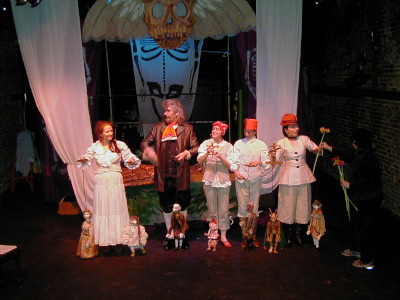 |
Vít Horejš and cast of
"Don Juan, or Wages of Debauchery" at Jan Hus Playhouse, 2014. |
He co-produced “Faust on a String,” an award-winning documentary about Czech puppetry, and wrote the lead essay for Czechoslovak-American Puppetry (GOH Productions, 1994). He has received commission grants from Henson Foundation, Mary Flagler Cary Charitable Trust, Foundation for Jewish Culture, Columbia University & New York Foundation for the Arts (none of them for whip braiding). In 2018, he received the SVU Award in recognition of a lifetime achievement in fostering the art of Czech and Slovak puppetry.
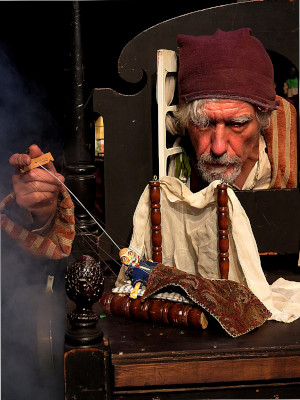 |
| "A Christmas Carol, Oy! Hanukkah, Merry Kwanzaa" (2014) -- Vít Horejš and Scrooge puppet. Photo by Line Krogh. |
Sporilov, his family’s Prague neighborhood, is the only urban area outside the U.S. that features American style numbered streets. Vit grew up on North-West 4th St. (Severozápadní ctvrtá ulice), with his family moving to N-W 2nd Street when he started braiding pomlázkas at the tender age of 7. He says this anomalous urban planning fact predisposed him to overseas emigration in 1979.
# # #
PRESS CONTACTS:
Jonathan Slaff, Press Rep, 212/924-0496, js@jsnyc.com
Vit Horejš, artist, 917/721-0139, czechmarionette@gmail.com
Bonnie Stein, Producer, GOH Productions, 917/721-6385, bonnie@gohproductions.org